The better shower does not ask people to want less comfort. It makes comfort less wasteful.
Water conservation works best when it protects the ritual people already value.
Most water-saving advice begins with a perfectly reasonable instruction: spend less time in the shower. In Australia, that advice has weight. Water is not an abstract environmental issue here; it is something people have seen restricted, rationed, priced, labelled and discussed through droughts, bills and household campaigns. A shower is also one of the most visible places where water becomes waste. Turn the handle, wait for warmth, stand there for a few extra minutes, and the litres disappear.
But there is a limit to how far a brand can go by repeating the same behaviour-change message. Shorter showers are sensible, but they are not emotionally generous. They frame the user as the problem and discipline as the solution. The person who wants ten warm minutes after work becomes someone who needs to be corrected. That may save water in theory, but it does not understand why people linger in the shower in the first place.
A long shower is rarely just about getting clean. It is a pause between one part of the day and another. It is privacy. It is warmth. It is a place where the phone is absent, the body relaxes, and the mind can drift without needing to perform. That drifting matters. Research on mind wandering suggests it can carry costs for immediate task focus, but can also support creative incubation and future planning under the right conditions. In everyday language, this is what people mean when they say their best thoughts arrive in the shower.
So the stronger conservation question is not simply, “How do we make people shower faster?” It is, “How do we design the shower so the valuable part remains, while the wasteful part shrinks?”
That shift changes everything. It moves the conversation from self-denial to design. It accepts that people are attached to the shower as a ritual, then asks the product to do more of the conservation work. This is the territory ShowerLoop can own. A conventional shower is a single-pass system: heated drinking water flows over the body briefly, then leaves. The longer the moment lasts, the more water and energy the system consumes. A recirculating shower challenges that assumption. It treats the long shower not as a moral failure, but as a design problem.
“The old model says: shorten the moment. The better model says: shorten the waste.”
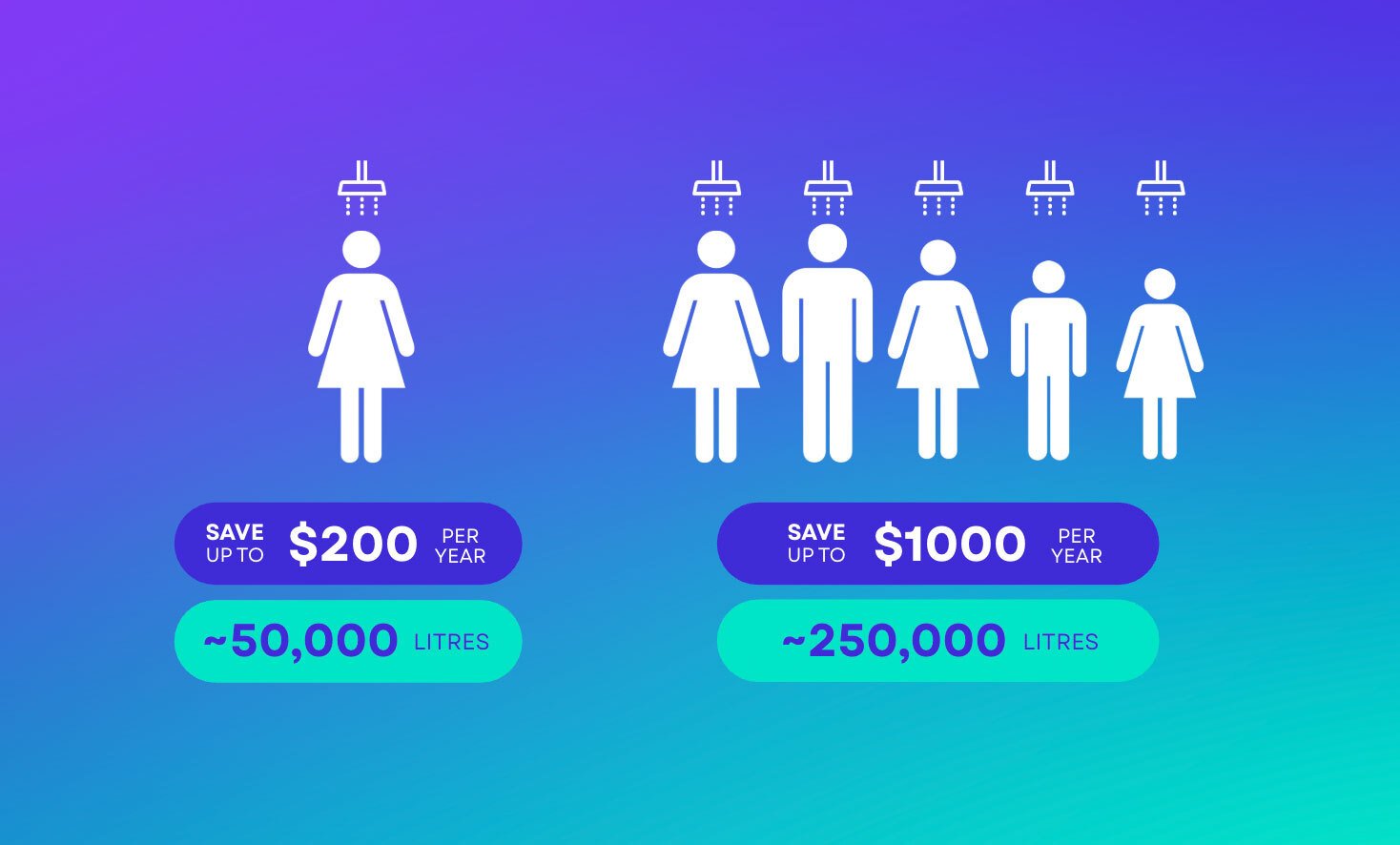
Australian sources already make the practical case for better shower design. Energy.gov.au explains that shower flow rates are shown in litres per minute on the water rating label, and that every 1 L/min difference can save a family of four nearly 12 kL of water each year. Water Corporation says showers account for 24% of household water use, while YourHome notes that reducing hot water use also cuts energy demand. These are not vague sustainability claims. They show that the shower sits at the intersection of water, energy, bills and daily comfort.
The usual answer is efficiency: install a better showerhead, use a timer, aim for four minutes. Those steps are useful. They should not be dismissed. But they still operate inside the same basic compromise. Keep the comfort and pay for it in water, or save the water and reduce the comfort. ShowerLoop’s more interesting promise is that the compromise itself can be redesigned.
This matters for the way the brand should speak. A guilt-led sustainability message asks people to become smaller. A comfort-led message gives people permission to want the thing they already want, while making that desire more responsible.
There is also a wellness angle, but it should be handled carefully. A warm shower can be part of an evening wind-down, and a systematic review found warm showering or bathing before bed may improve some sleep outcomes when timed well. That does not turn a shower into medicine. It simply reinforces a more human point: showers are part of how people regulate the day. They mark transitions. They help people settle. They create a private sensory environment that other household products rarely provide.
For ShowerLoop, the opportunity is to stop apologising for the long shower and start explaining how it can be made smarter. The brand can agree with conservation goals while offering a better route. Yes, water matters. Yes, hot water carries an energy cost. And yes, people still deserve comfort.
The future of water conservation will not be built only from timers, reminders and sacrifice. It will also come from products that respect human behaviour deeply enough to redesign around it. The better shower is not the one that wins by making the user feel guilty. It is the one that lets a person step in, slow down, think clearly, and step out knowing the ritual did not require waste on the old scale.
“Good design does not shame the ritual. It removes the unnecessary cost of keeping it.”
## Source links
- energy.gov.au — Water efficiency: https://www.energy.gov.au/households/water-efficiency
- Water Corporation — Saving water during shower time: https://www.watercorporation.com.au/Help-and-advice/Waterwise/Bathroom/Saving-water-during-shower-time
- YourHome — Reducing water use: https://www.yourhome.gov.au/water/reducing-water-use
- ScienceDirect — Before-bedtime passive body heating review: https://www.sciencedirect.com/science/article/abs/pii/S1087079218301552
- Scientific Reports — Mind wandering and creative incubation: https://www.nature.com/articles/s41598-017-10616-3
- ShowerLoop: https://showerloop.com/




Comments